Evergreen Niches for a Faceless Compilation Channel: How to Pick One Well and Dig
The difference between a video and an asset
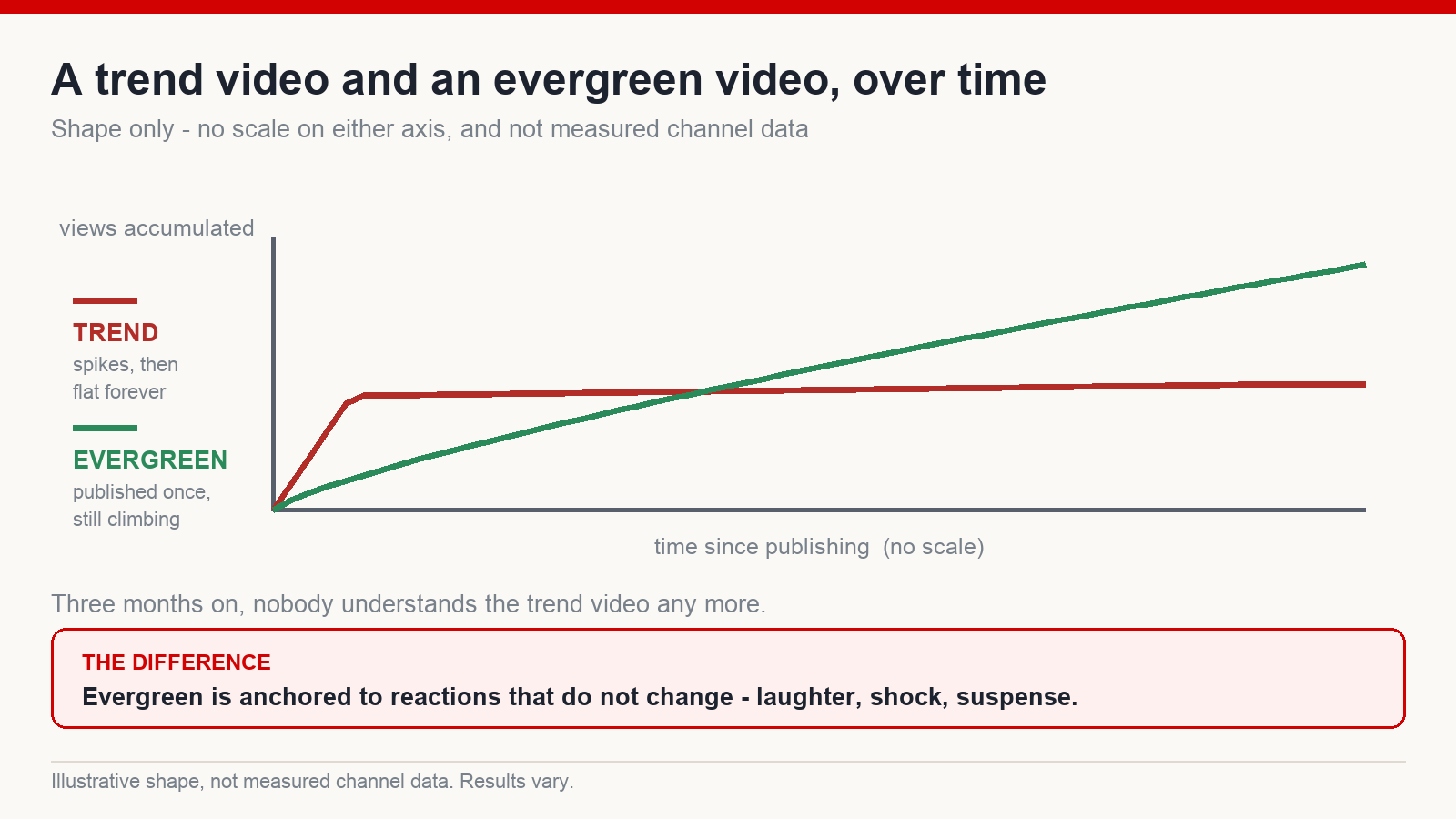
Picture two kinds of video sitting on the same page.
The first one rides a trend. It goes up fast, collects a pile of views over a week or so, and then the tap closes. Three months later nobody watching it would even understand what it was about. Single-use content: burned, gone.
The second one is an asset. Published once, then quietly accumulating views for years. Nothing re-uploaded. No advertising spend. It simply sits there generating attention.
Now hold this in your head, because it is the whole reason this article exists: the second kind is not luck. It is a format, and formats can be learned.
I know what your evening looks like, because it was mine. You spend a night editing, you publish, and three days later you check back and find a few hundred views and total silence. Then you ask the question I asked myself a hundred times – maybe I am just not cut out for this.
I want to argue you out of that, using the format rather than a pep talk. Compilation channels built on human emotion have been running the same playbook for well over a decade, and the parts you are allowed to take from it are the parts that cost nothing to take. In this article I am going to unpack the format, show you how the good ones split one channel into several evergreen sub-niches, give you the three tests I use to pick one, and then draw a hard line around the part you must not copy.
What evergreen actually means, and why emotional compilations do not expire
Evergreen is a word people throw around without defining. Here is the working definition I use: a video that makes as much sense to a stranger five years from now as it does today.
Why do emotional compilations qualify? Because they are anchored to the things about people that do not change. Laughing at a well-timed pratfall. Flinching at a near miss. The small satisfaction of watching someone rude get what was coming to them. Those reactions were identical a decade ago and they will be identical a decade from now. A video about this week’s controversy is out of date by next month. A video that makes somebody laugh does not have an expiry date.
I got this wrong for years. There were videos I ground away at for a week, built and rebuilt, published, and watched sit at a few hundred views. Meanwhile the things that kept collecting views were the ones that reached for a feeling everybody already had.
So the advice comes out short: do not pick a subject because it is hot this week. Pick it because people will still react to it in ten years. Trends cool. Laughter does not.
One thing to be honest about, because I do not want you building a plan on a fantasy. Evergreen does not mean guaranteed. It means the ceiling on a video’s life is much higher, and that it is worth building carefully because it will be working for you long after you have forgotten making it. It is a property of the format, not a promise about your results.
Anatomy of the compilation format: packaging emotion so it can be repeated
You know why the format lasts. Now let us take it apart and see how it is assembled.
Watch a good compilation and notice that it never gives you time to get bored. Every few seconds, another hit. A stumble, a near miss, a moment that makes you say “oh no” out loud – then cut, next scene. A compilation is not clips poured into a bucket until it reaches fifteen minutes. It is the craft of compressing feeling: a touch every few seconds, so your hand never reaches for the close button.
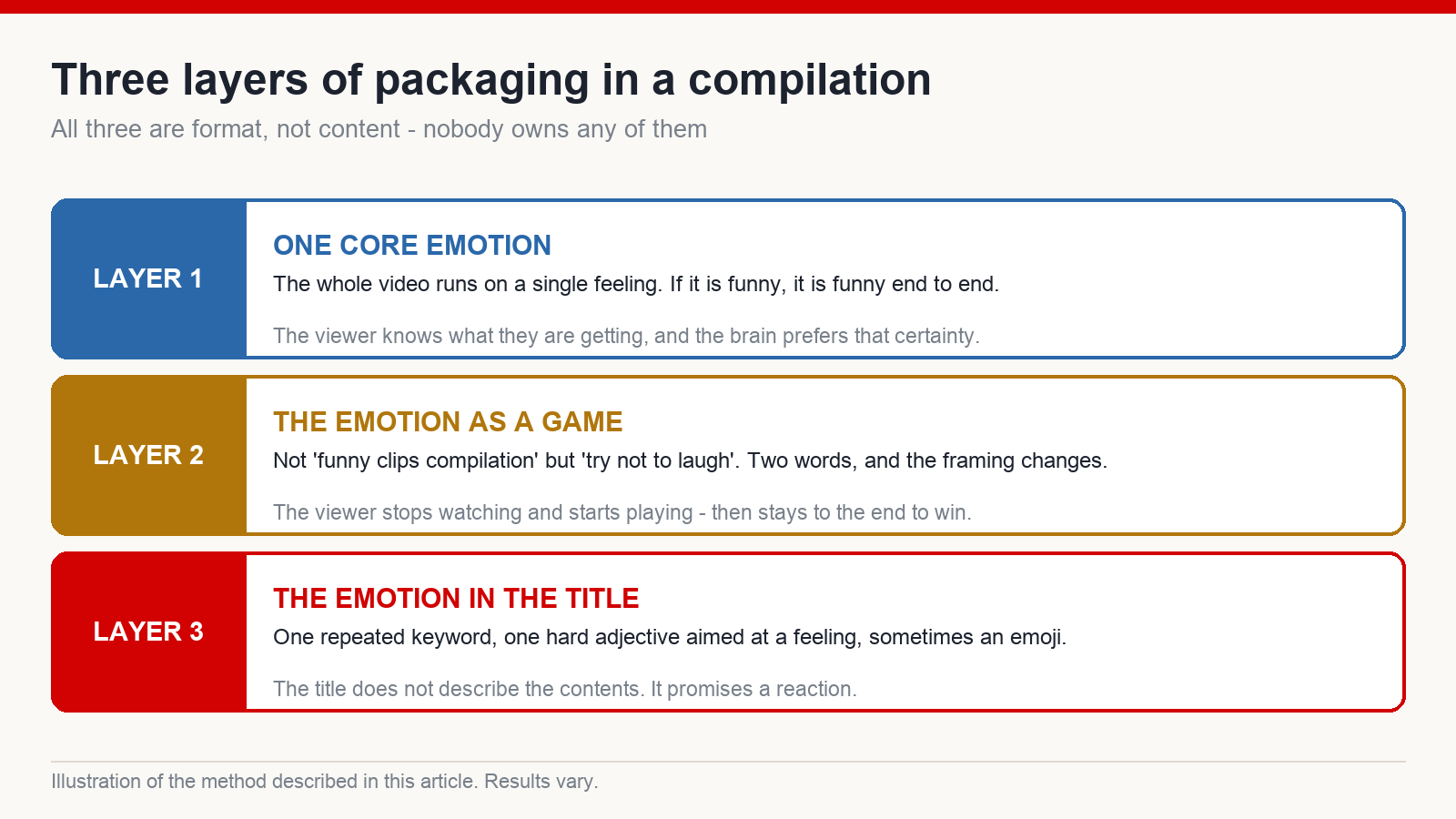
Pull it apart and there are three layers of packaging, all of them copyable.
One: the whole video runs on a single core emotion. No greed. If it is meant to be funny, it is funny from start to finish; if it is meant to make you wince, it winces the whole way. The viewer knows in advance exactly what they are getting, and the brain likes that certainty more than it likes surprise.
Two: the emotion is turned into a game. The strongest channels in this format do not label a video “funny clips compilation”. They call it something like a “try not to laugh challenge”. Change a couple of words and the viewer stops being a passive watcher and becomes a player – “let us see how long I last” – and then watches the whole thing to win. It is an elegant trap and it costs nothing.
Three: the emotion is packaged into the title itself. Look at how the big compilation channels write titles: one keyword repeated across the whole library so the channel is instantly recognisable, then a hard adjective aimed straight at a feeling – insane, expensive, shocking – and often an emoji so it is identifiable at a glance in a crowded feed. The title does not describe the contents. It promises a feeling.
Why does this frame win with the algorithm? Because it holds people longer, and because it can be repeated almost indefinitely. One channel can run hundreds of videos on the identical template without exhausting it.
So your job here is small and specific: pick one core emotion, then make the title a promise of that emotion rather than a description of the footage.
Splitting one format into evergreen sub-niches
You have the packaging. But packaging what? This is the point where a lot of people trip, and I did too.
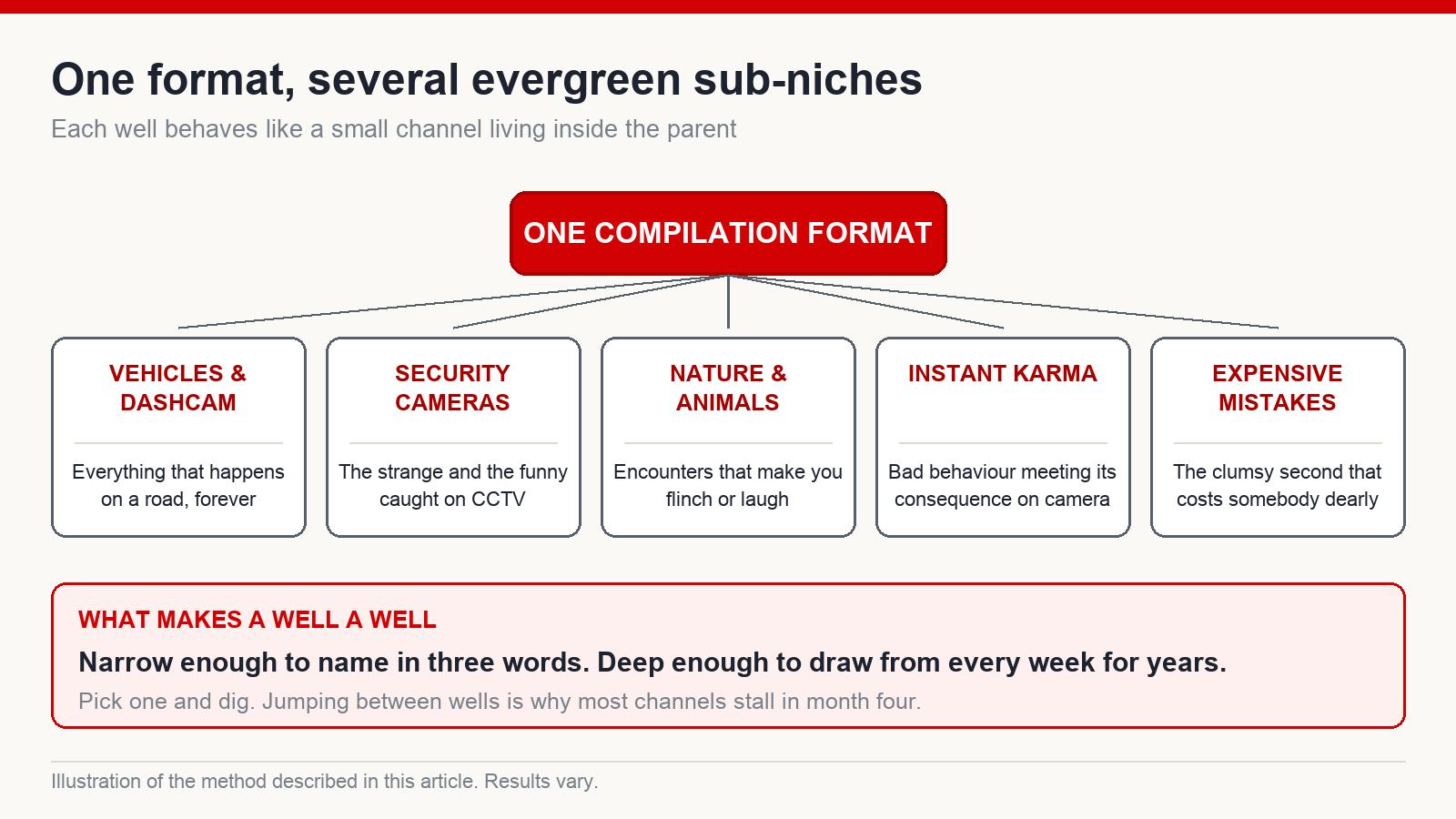
You look at a big compilation channel and assume it just makes “fail videos” – anything funny gets thrown in. Wrong. Read the video titles carefully and you see a large channel split into clearly separated sub-niches, each behaving like a small channel living inside the parent. And each sub-niche is a well of material that does not run dry, which is exactly why these channels can publish near-daily for years without running out of things to say.
The wells look something like this. Vehicles and dashcam footage – the endless stream of things that happen on roads. Security-camera moments – the strange, funny, unbelievable things that get caught on CCTV. Nature and animals – encounters that make the viewer flinch or laugh. Instant karma – the deeply satisfying genre where somebody behaving badly collects their consequence on camera. Expensive mistakes – the clumsy moment that costs somebody a great deal, which everybody watches through their fingers.
Five wells, one format. Notice that each one is narrow enough to name in three words and deep enough to draw from every week for years.
Three tests before you commit to a sub-niche
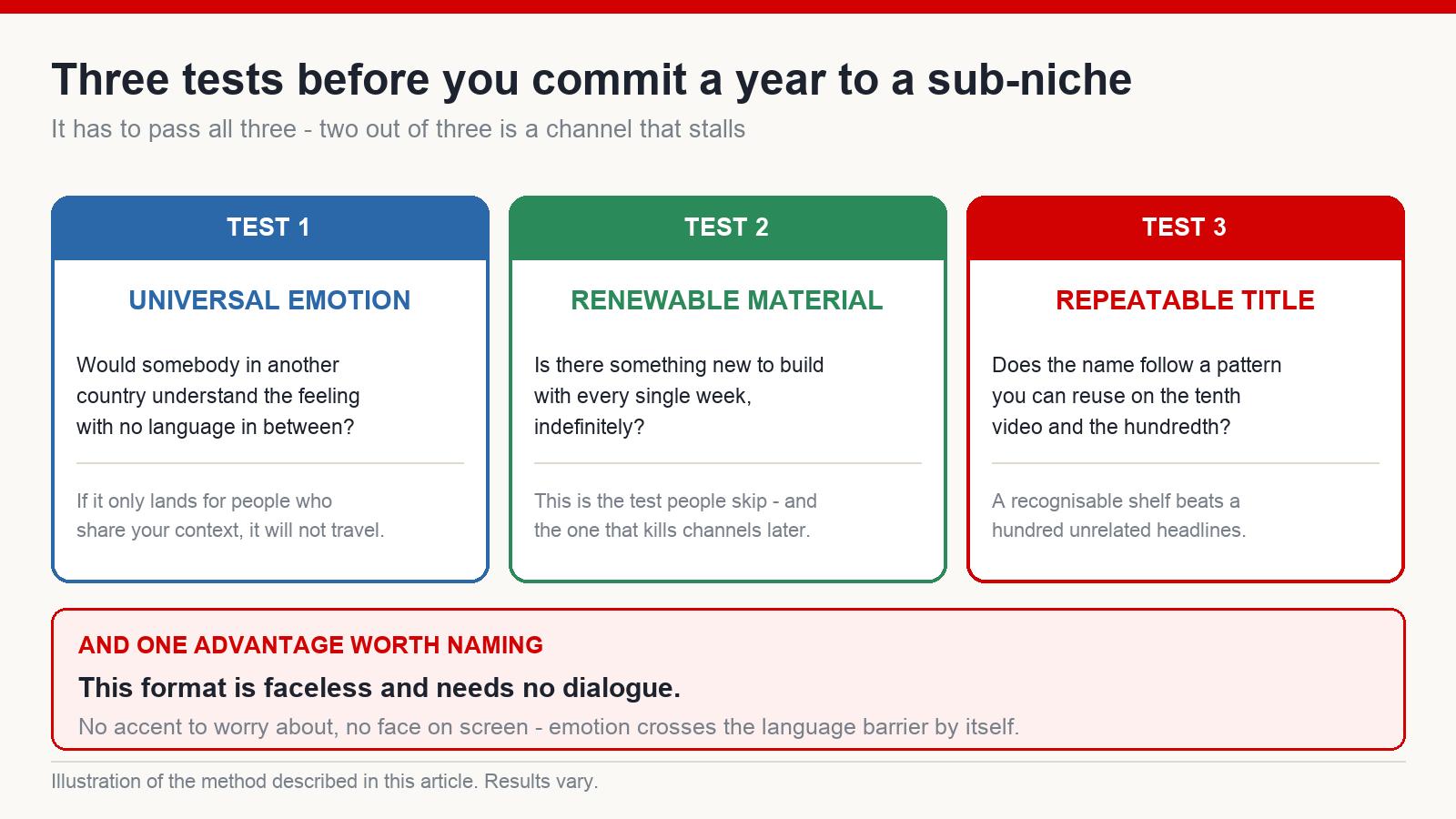
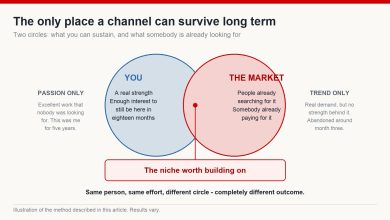
So how do you pick one for yourself? I run every candidate through three tests, and it has to pass all three.
Test one: is the emotion strong and universal? Laughter, shock, suspense, satisfaction – reactions somebody in the United States, Germany or Japan understands instantly without a word of language in between. If the feeling only lands for people who share your context, it will not travel.
Test two: is the material renewable? Can you find something new to build with every single week, indefinitely? Do not choose a well you will empty in three days. This is the test people skip, and it is the one that kills channels in month four.
Test three: does the title have a repeatable template? The name has to follow a pattern you can reuse, so that the tenth video and the hundredth video are recognisably from the same shelf. Many of the big compilation channels also attach a year to the title, which gives the same format a fresh reason to exist each time around.
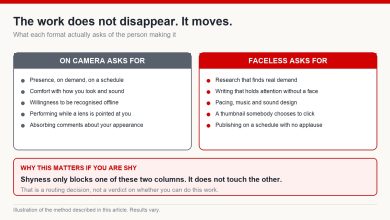
And here is the part that genuinely matters if you are not a native English speaker: this format is faceless and needs no dialogue. You do not have to speak English on camera. You do not have to show your face. You do not have to worry about your accent. Emotion crosses the language barrier by itself, which is precisely why it works for a creator aiming at audiences in the United States, the United Kingdom, Germany or Japan, where advertising rates tend to run higher than in smaller markets. How much higher varies constantly by niche, season and audience country, so treat that as a reason to aim there rather than as a number you can plan around.
Pick one well. Then dig it deep, and stop jumping between wells.
Repeatable is not the same as lucky
Having chosen a well, the next question is what happens if you actually work it consistently. For my first few years on this platform I assumed views were a coin toss. Publish and pray.
What changed my mind was looking properly at how a mature compilation channel performs across its whole library rather than at its one famous video. The pattern that shows up is not a lottery. A channel like that publishes on a near-daily rhythm and its typical video – not its best one, its median one – performs in a range that stays fairly consistent over time. The outliers are outliers. The middle is the story.
That middle is what I want you to notice, because it is the thing you can actually reason about. When the format is right and the sub-niche is right, results stop being an event that either happens or does not, and start being a distribution you can nudge. The difference between that channel and the one I ran badly for years was never talent. It was doing the right format inside the right well, repeatedly and stubbornly, so that every upload was another seed in ground that had already been tested.
Let me be honest about the ceiling, though. A mature channel with a decade of authority behind it is not a fair comparison for a channel you started last month, and I am not going to pretend otherwise. Nobody can promise you any particular outcome; it depends on the niche, the craft, the consistency, and a genuine amount of algorithmic luck. What I will claim is narrower and, I think, more useful: when the format and the niche are right, results stop being random. And anything that is not random can be learned.
The line: learn the format, do not copy how they source clips
Now the part I have to say plainly, before enthusiasm walks you into the hole I watch beginners fall into. You are allowed to learn the format. You are not allowed to copy how these channels get their material. Those two things are worlds apart.
Why? Because a channel of that size is not a person in a bedroom collecting clips. The large compilation channels are operated by media companies whose actual business is buying and licensing viral user-generated footage. They have the money to license each individual clip legally, and they have a legal department behind them. Their right to gather other people’s clips and cut them together is a right they purchased, with contracts.
You, starting out, have neither. Imitate them literally – download somebody’s clip, cut it in, publish – and you are very likely looking at a copyright strike, a demonetized video, possibly a lost channel. I am not trying to frighten you. I have watched it happen repeatedly.
So what do you keep and what do you drop? Keep the core: the compilation format, the way sub-niches are chosen, the emotional packaging, the evergreen quality. Drop their sourcing model. In its place, use the frame I teach: the five-source blend. Short fair-use excerpts kept under five seconds, licensed stock footage, material you filmed yourself, generated shots, and your own recorded audio – mixed together so that no part of the finished video is anybody’s clip carried over whole.
My shorthand for it is: blend everything, go pure on nothing. My own fair-use boundaries are explicit – no excerpt over five seconds, avoid broadcaster footage entirely, and always mix sources so nothing reads as a lift. To be straight with you: fair use is a genuinely grey area that varies by platform, by jurisdiction and by what the source material is. This is a risk-reduction practice I built from experience, not legal advice. For anything consequential, talk to somebody who actually knows copyright law where you live.
You do not need to copy anybody’s content. You are learning how to package. That is the part nobody can come after you for – and it is the part that makes the channel yours.
What to do this week
Everything above reduces to two drawers.
The first drawer, what you can take: the consistency, publishing on a rhythm rather than waiting for inspiration. The evergreen quality, choosing subjects that will still land in ten years. The emotional packaging compressed into title and thumbnail, so people want to click before they have thought about it. And spreading across formats, publishing short vertical cuts in batches so the algorithm keeps being reminded you exist. None of those four costs you a licensing fee.
The second drawer, what you must leave alone: the clip-licensing machine. That belongs to a company with cash and lawyers. Not to you, and not to me.
I say that firmly because I paid for the alternative. I spent years waiting to discover I had a natural talent for this, failing the whole time, half convinced I was simply not suited to it. Then I rebuilt from the format upwards and things started working. The format was something I could hold in my hands. The talent never showed up.
So this week, do not take on much. Pick exactly one sub-niche – one you can watch endlessly without tiring of it, because you are going to live inside it for a year. Lock exactly one core emotion: laughter, suspense, or satisfaction. Then build one short compilation using the five-source blend. Just one. Finish it.
You have the map now. One step is enough, as long as it happens tonight.
What is evergreen content on YouTube, and how is it different from a trend?
Evergreen content still makes sense to a viewer years after it was published, so it keeps collecting views long after you published it. A trend goes up quickly, pulls views for a few days and then becomes incomprehensible. If you want a channel that compounds, choose subjects anchored to reactions people will still have in ten years – laughter, shock, suspense – rather than to this week’s news.
Will making compilation videos get me copyright strikes?
Lifting somebody’s clips and cutting them together carries very high risk: strikes, demonetization, potentially the channel. The large compilation channels can do it because they are companies that license footage and employ lawyers. A beginner should use the safer route – the five-source blend, with fair-use excerpts under five seconds, licensed stock, your own filming, generated shots and your own audio, mixed so nothing is carried over whole. This reduces risk; it is not legal advice, and anything consequential deserves a real copyright lawyer.
Can I build for an English-speaking audience if my English is weak?
Yes, and this format is exactly why. It is faceless and needs no dialogue – laughter and suspense cross the language barrier on their own. You do not have to speak on camera or show your face, which is what makes it accessible to a creator aiming at audiences in the United States, the United Kingdom, Germany or Japan.
How do I choose a faceless sub-niche properly?
Three tests, and it has to pass all three: the emotion is strong and instantly readable in any country; the material is renewable enough that you find something new every week for years; and the title follows a repeatable template so the whole library is recognisable. Then commit to that one well and dig, rather than jumping between them.
How long before this starts working?
There is no shared timeline and I will not invent one. It depends on the niche, your publishing rhythm, the quality of the work and how long you keep going. What I am confident about is that choosing the right format and the right well means the effort is at least pointed somewhere, which is more than I could say for my first few years.
A note on method: the framing above is drawn from my own work and from studying public compilation channels, not from any published platform standard. Nothing here promises views or income – results vary enormously with niche, craft, consistency and timing. Copyright rules and platform policies also change, so check the current position yourself before you publish.
Written by Phuc, a YouTube trainer who has been building on the platform since 2017 – nine years – working mainly on faceless channels aimed at English-speaking audiences.
The full step-by-step system I run with the creators I work with lives at mmoyoutube.com.